








Your body runs on a precise internal schedule. Every organ has its time – its golden hour when it works at full capacity and when you can support it most effectively. Traditional Chinese medicine has described this plan for thousands of years. Modern science is only now beginning to fully understand it.
When the body speaks – and we don't listen
Imagine your body is an orchestra. Every instrument has its moment to play the solo – and its moment to step back. If the violins come in when the double basses should be playing, the result is cacophony. That is exactly what a disrupted biorhythm looks like.
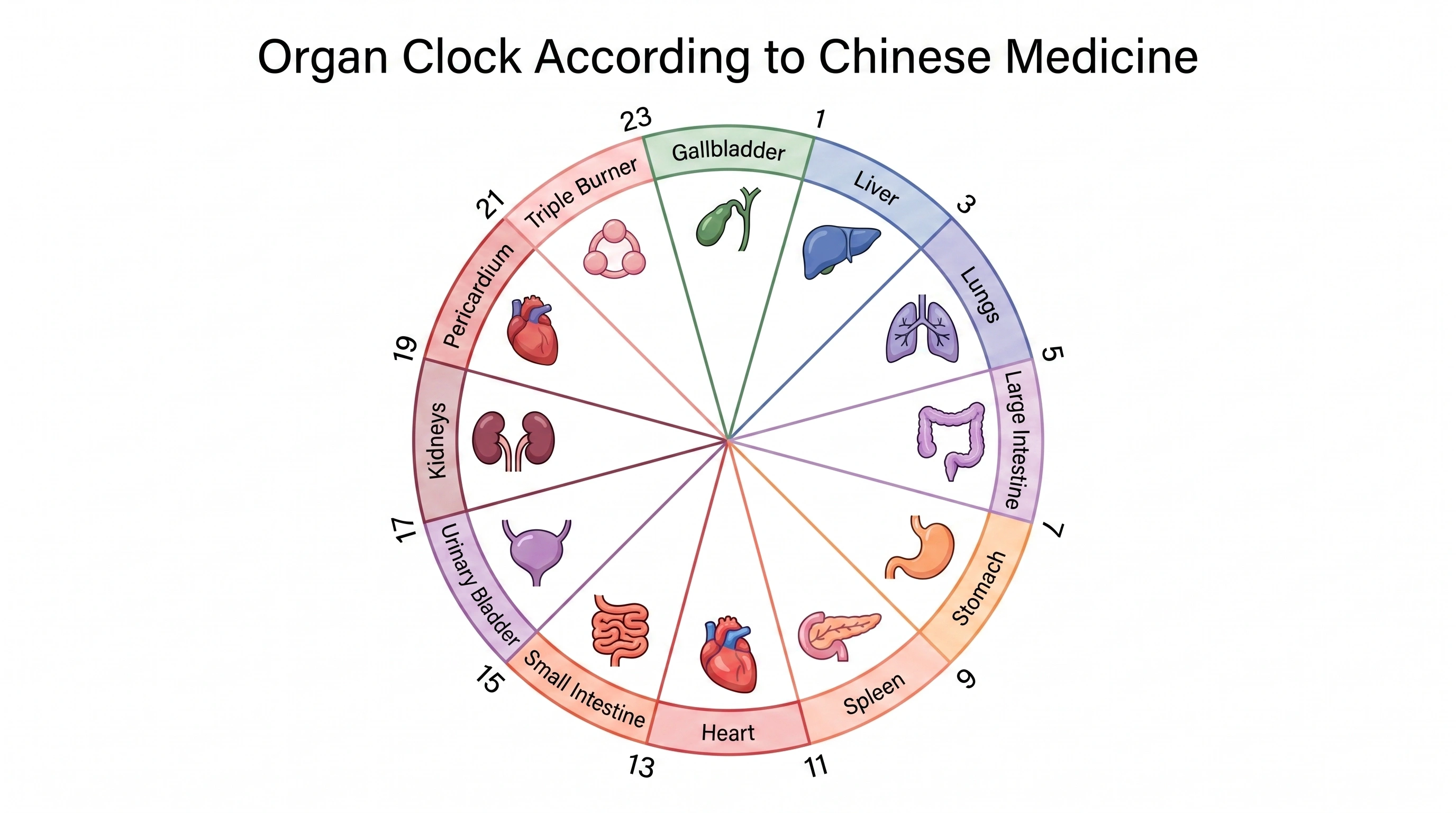
Traditional Chinese medicine (TCM) described this orchestra more than 2,000 years ago. It called it the organ clock system – a 24-hour cycle in which the life energy Qi flows through all twelve main organs in sequence. Each organ receives its two-hour „peak“ – the time of greatest activity, regeneration, and at the same time greatest vulnerability.
What ancient Chinese physicians observed empirically over centuries is now confirmed by modern science under a different name: circadian rhythms. Their research is so fundamental that it was awarded the Nobel Prize in Physiology or Medicine in 2017.
Nobel Prize 2017 – circadian clocks
Jeffrey Hall, Michael Rosbash and Michael Young demonstrated that every cell in the body contains its own molecular clock – a set of genes (CLOCK, BMAL1, PER, CRY) that govern the 24-hour cycle of cellular activity. Disruption of these clocks – for example through shift work or chronic sleep deprivation – is associated with an increased risk of type 2 diabetes, cardiovascular disease, depression and certain types of cancer. The body truly „knows“ what time it is – and responds accordingly.
What is the TCM organ clock?
In TCM, an organ is not merely an anatomical structure. It is an entire functional system – encompassing the physical organ, its meridian (energy pathway), its associated emotion, sense, tissue, season and time of day. The liver is not just a „blood filter“ – it is the seat of planning, decision-making and the emotions of anger and frustration.
Qi – life energy – flows through the body like a wave. Every two hours it reaches its peak in a different organ. At the same time, the organ directly opposite in the circle (exactly 12 hours offset) is at its lowest point. The liver is most active between 1 and 3 a.m. – and its counterpart, the small intestine, is at its lowest point of activity at that time.
The TCM organ clock system and modern chronobiology agree on one essential point: timing is just as important as the treatment itself. Medications taken at the right hour can be significantly more effective than the same dose at the wrong time – this field is called chronopharmacology and is actively used, for example, in oncology.
Through 24 hours – organ by organ
Let's walk through the entire day. Not only from the TCM perspective, but also from the viewpoint of modern biology – and wherever the two perspectives meet, we'll pay special attention.
Gallbladder
TCM: In TCM, the gallbladder is not merely a bile reservoir. It is the organ of decision-making and courage. It is said that a courageous person has a „large gallbladder“. It governs the ability to make clear decisions and act without hesitation. The emotion associated with the gallbladder is indecisiveness, bitterness and resentment – a sense of injustice that cannot be let go.
Biology: At night the gallbladder concentrates bile and prepares it for the morning digestion of fats. Eating fatty foods late in the evening overloads it precisely during its peak time. Studies show that eating at night increases the risk of gallstone formation.
Wake-up signal: If you regularly wake between 11 pm and 1 am, TCM links this to an overloaded gallbladder or indecisiveness – to „chewing over“ a situation that has no resolution.
Tip: Prioritise quality sleep. A light dinner no later than 7 pm.
Liver
TCM: The liver is the „general of the army“ in TCM – it plans, organises and ensures the smooth flow of Qi throughout the body. It is the seat of the soul Hun – the part of consciousness that dreams, creates and plans the future. The emotion of the liver is anger, frustration and suppressed rage. Chronic anger literally weakens the liver.
Biology: Between 1 and 3 a.m. the detoxification enzymes CYP450 are maximally active – the liver processes alcohol, medications, hormones and metabolic waste products during this time. Waking at this hour may signal an overload of the detoxification pathways.
Wake-up signal: The classic „3 a.m. wake-up“ – you wake with racing thoughts, planning or a feeling of anger. Both TCM and modern psychosomatics link this to unresolved frustration.
Tip: Reduce alcohol and late-night meals. Support detoxification with adequate hydration.
Lungs
TCM: The lungs are the „prime minister“ – they receive Qi from the air and distribute it throughout the body. They are the seat of the soul Po – the corporeal soul connected to instincts and physical survival. The emotion of the lungs is grief, sorrow and mourning. People going through loss are more susceptible to respiratory infections in TCM.
Biology: Between 3 and 5 a.m. body temperature and blood pressure are at their lowest. The lungs are preparing for the morning awakening – cortisol production begins to rise. Asthma attacks are most frequent at this time because the bronchial tubes are at their narrowest.
Wake-up signal: Coughing, breathlessness or deep sadness without obvious cause. TCM recommends paying attention to grief that has not been fully expressed.
Tip: A well-ventilated bedroom, a humidifier in winter, conscious breathing before sleep.
Kidneys & Large intestine
TCM: The large intestine is the organ of „letting go“ – physically and metaphorically. It clears the body of what it no longer needs. Emotionally it is connected to the ability to release, let go and move on. The kidneys are the „root of life“ – they store the innate life essence and are the seat of willpower.
Biology: Large intestine peristalsis is most active in the morning after waking – which is why a morning bowel movement is physiologically natural. Cortisol, rising from around 4 a.m., stimulates intestinal motility. Morning movement and a glass of warm water significantly support this process.
Tip: A glass of warm water immediately upon waking. Gentle stretching or a short walk.
Stomach
TCM: The stomach is the „minister of supply“ – it receives, processes and distributes nourishment. It is the seat of Yi – intellect and the capacity for concentration. The emotion of the stomach is anxiety, worry and circular thinking. Chronic anxiety literally disrupts digestion – and vice versa.
Biology: Stomach acid reaches its morning peak. Digestive enzymes are maximally ready. Breakfast between 7 and 9 a.m. is ideal from a chronobiological perspective. Skipping breakfast raises cortisol levels and stress reactivity for the rest of the day.
TCM tip: Warm, cooked breakfast – porridge, soup, eggs. Cold and raw foods in the morning „extinguish the stomach fire“.
Spleen / Pancreas
TCM: The spleen (which in TCM also encompasses the function of the pancreas) is the „minister of transformation“ – it transforms ingested food into Qi and blood. It is the seat of Yi – thinking, memory and concentration. The emotion of the spleen is overthinking, worry and mental overload. Students and people doing demanding intellectual work have a chronically weakened spleen in TCM.
Biology: The late morning is the peak of cognitive performance – cortisol is still high and the brain is supplied with glucose. Studies show we should schedule our most demanding mental work for 9–11 a.m. The pancreas regulates blood sugar – and its rhythm is directly linked to meal timing.
Tip: The most challenging tasks and important decisions belong in this window. The brain is at its peak.
Heart
TCM: The heart is the „emperor“ – the ruler of all organs. It is the seat of Shen – consciousness, spirit, joy and the capacity to love. The emotion of the heart is joy – but also its excess (manic euphoria) or its absence (depression). The heart „houses the mind“ in TCM – which is why sleep, memory and consciousness disorders are always connected to the heart.
Biology: Heart rate and blood pressure reach their late-morning peak. Studies show that heart attacks are most common between 6 a.m. and noon – precisely when the cardiovascular system is under the greatest strain. Lunch should be calm – stress during eating increases the risk of arrhythmias.
Tip: A lunch break is not a luxury – it is a physiological need of the heart. The ideal time for light cardio or a walk.
Small intestine
TCM: The small intestine is the „minister of receiving and transformation“ – it separates the pure from the impure, the nourishing from the waste. Metaphorically it is connected to the ability to discern, set priorities and separate the essential from the non-essential. People with an overloaded small intestine tend towards mental chaos in TCM.
Biology: The afternoon energy dip (the so-called „post-lunch dip“) is caused by blood shifting to the digestive tract after lunch. The small intestine is in full operation – absorbing nutrients, vitamins and minerals. A short rest after lunch (10–20 minutes) is a chronobiologically supported need.
Tip: Avoid heavy meals and stress at lunchtime. Give the intestine space to work.
Bladder
TCM: The bladder belongs to the Water element in TCM, together with the kidneys. It is associated with memory, learning and fear. The afternoon hours are ideal in TCM for study and memorisation – the energy of the bladder supports mental capacity.
Biology: The afternoon (3–5 pm) is the second peak of cognitive performance of the day – reaction time is shortest, muscle strength greatest, coordination best. Athletes achieve their best performances precisely at this time. Remember to stay well hydrated.
Tip: The ideal time for sport, physical activity or demanding meetings.
Kidneys
TCM: The kidneys are the „root of life“ – they store Jing, the innate life essence, which is finite and cannot be renewed, only conserved. They are the seat of willpower (Zhi) and fundamental life force. The emotion of the kidneys is fear and existential anxiety. Chronic stress literally „depletes kidney Jing“.
Biology: The kidneys filter approximately 180 litres of blood per day. Aldosterone production peaks in the afternoon – the hormone that regulates sodium and potassium balance. Blood pressure is at its highest at this time.
Tip: A light, warm dinner no later than 7 pm. Time for regeneration and fluid replenishment.
Pericardium
TCM: The pericardium is the „protector of the emperor“ – it shields the heart from external influences, especially emotional ones. It is the seat of intimacy, relationships and the ability to open up to others. The emotion of the pericardium is emotional withdrawal or, conversely, emotional dependency. Evening hours are ideal in TCM for deep conversations and intimacy.
Biology: Cortisol drops in the evening and melatonin rises. The body switches from „fight“ to „rest“ mode. The parasympathetic nervous system takes over – heart rate drops, digestion slows.
Tip: Time for relationships, laughter and quiet conversation. Ideal for meditation or yoga.
Triple warmer
TCM: The triple warmer (San Jiao) is the only TCM organ without an anatomical equivalent in Western medicine. It regulates the body's overall energy balance – distributing heat and energy between the upper (heart, lungs), middle (stomach, spleen) and lower (kidneys, intestines) body. It is associated with stress regulation, immunity and adaptation to change.
Biology: The closest analogy is the autonomic nervous system and the HPA axis (hypothalamus–pituitary–adrenal glands). Sympathetic activity should be declining by evening. Blue light from screens at this time blocks melatonin production and keeps the body in „standby“ mode.
Tip: Switch off screens or use a blue light filter. A warm bath, reading, calm music.
Emotions and organs – what does psychosomatics say?
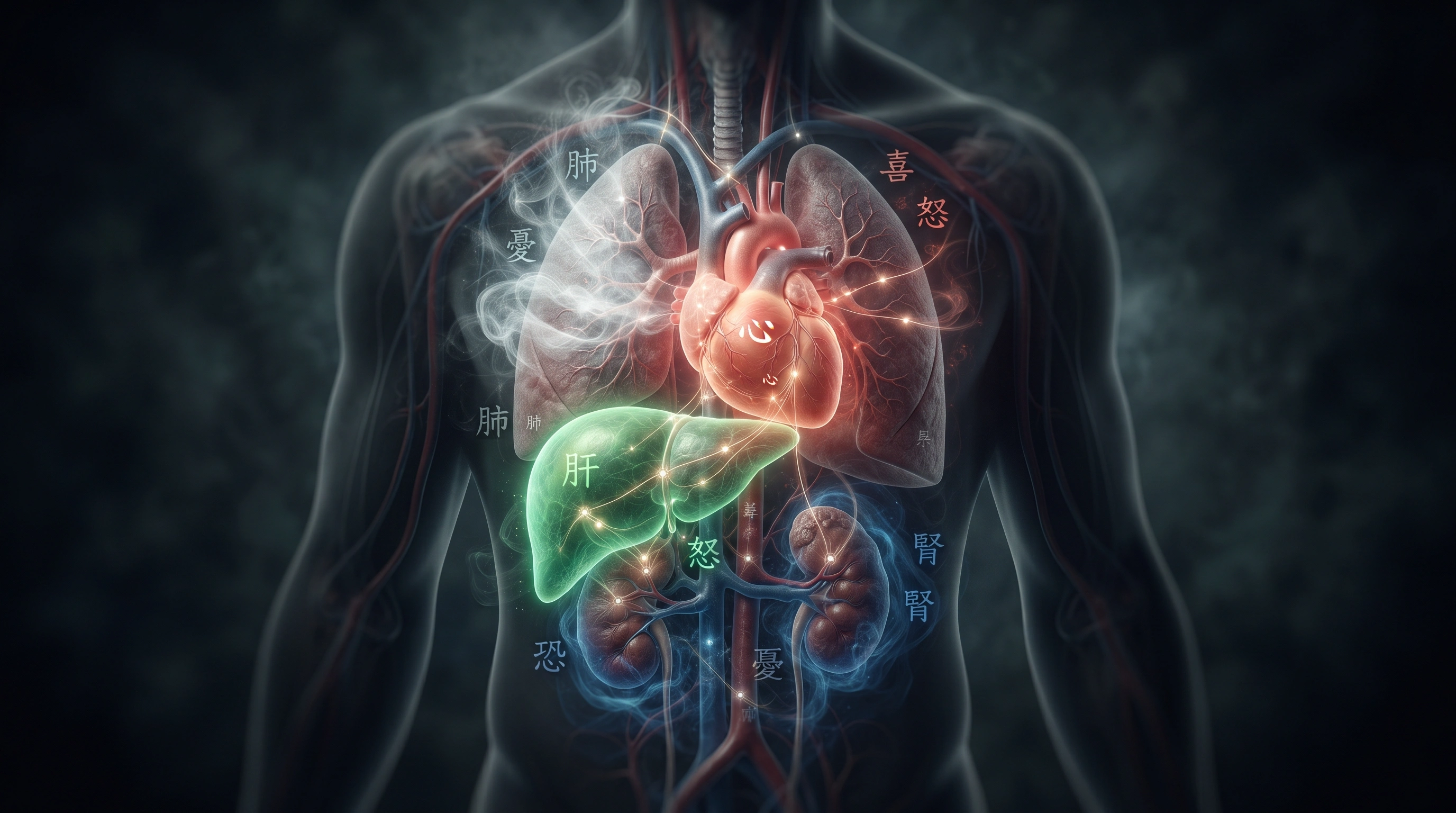
TCM assigns a specific emotion to every organ. What for centuries appeared to be a poetic metaphor now finds scientific confirmation in the field of psychoneuroimmunology – the science of the connection between the psyche, the nervous system and immunity.
Emotions and organ function – what the research shows
Research published in the journal Psychosomatic Medicine demonstrated that chronic anger raises levels of inflammatory markers (IL-6, CRP) and is associated with a higher risk of cardiovascular disease – precisely the organs TCM links to anger (liver → heart). Studies from the University of Michigan showed that suppressed grief reduces the immune response of the lungs. Psychosomatics is not alternative medicine – it is science.
Anger → Liver
Chronic anger raises liver enzymes and inflammatory markers. TCM and modern medicine agree: unresolved anger burdens the liver.
Grief → Lungs
People after the loss of a loved one are demonstrably more susceptible to respiratory infections. Grief literally „constricts“ the lungs.
Fear → Kidneys
Chronic stress raises cortisol levels, which damages kidney tubules. Existential fear „depletes the life essence“.
Anxiety → Stomach
The gut-brain axis is today one of the fastest-growing fields in medicine. Anxiety literally disrupts digestion.
Night as the golden time of regeneration
While the day belongs to activity, the night belongs to repair. And not every hour of sleep is equally valuable.
Why is sleep before midnight so important?
Deep sleep (NREM stage 3) is concentrated in the first third of the night – roughly between 10 pm and 2 am. It is precisely during this time that:
- Growth hormone production is at its maximum (tissue repair, muscle building)
- Glymphatic brain cleansing takes place – removing metabolic waste including beta-amyloid linked to Alzheimer's disease
- Liver and gallbladder activity peaks – blood detoxification
- Memory consolidation occurs – transferring information from short-term to long-term memory
- The immune system regenerates – producing T-lymphocytes and NK cells
Every hour of sleep lost before midnight is more valuable from a regeneration standpoint than an hour after it.
The glymphatic system and sleep
Research by Maiken Nedergaard at the University of Rochester (published in Science, 2013) revealed that the brain has its own „sewage system“ – the glymphatic system – which is active almost exclusively during sleep. Brain cells shrink by 60% at night, allowing cerebrospinal fluid to flush through the intercellular spaces and carry away toxic proteins. Sleep deprivation leads to their accumulation, which is associated with neurodegenerative diseases.
Two phases of sleep – maybe your body isn't failing
You may be surprised to learn that regularly waking in the middle of the night does not have to be a sleep disorder. Historical records and the research of historian Roger Ekirch document that our ancestors naturally slept in two phases – a first sleep from dusk, a natural awakening around midnight, an hour of quiet, prayer or conversation, and then a second sleep until morning.
The Industrial Revolution and electric lighting broke this rhythm. Today's pressure for „a perfect 8 hours straight“ is a modern invention – and it may itself be a source of sleep-related stress. If you wake between 2 and 3 a.m. and cannot fall back asleep, your body may not be failing. The TCM organ clock adds another layer: this hour belongs to the liver – and if you wake during it with racing thoughts or a sense of unease, it is an invitation to pay attention to what is „smouldering“ within you.
The key is not panic but calm: stay in bed, don't reach for your phone, let the body do its work.
Biphasic sleep – historical research
Historian Roger Ekirch spent 16 years studying historical sources and in 2001 published a groundbreaking study documenting biphasic sleep as a natural human pattern. Records from diaries, court documents and medical texts from the pre-industrial era repeatedly mention „first sleep“ and „second sleep“ as an unremarkable part of the night. Psychiatrist Thomas Wehr at the NIH (National Institute of Mental Health) confirmed this pattern under laboratory conditions – when people lived without artificial lighting, they naturally returned to a biphasic rhythm.
Chronobiology in practice – when to take vitamins, when to exercise, when to eat
The organ clock is not merely a philosophical concept. It has very practical implications for how we organise our day. The field known as chronopharmacology studies how timing affects the efficacy of medications and supplements.
| What | Best time | Why |
|---|---|---|
| Vitamin D | Morning with food (7–9 am) | Better metabolised with fats from breakfast; supports the morning cortisol rhythm |
| Magnesium | Evening (7–9 pm) | Supports muscle and nervous system relaxation; improves sleep quality |
| Vitamin C | Late morning (9–11 am) | Peak immune activity of the spleen; better absorption during active digestion |
| Omega-3 | With lunch (11 am–1 pm) | Absorption of fat-soluble substances is best at the peak of digestive enzymes |
| Probiotics | Morning on an empty stomach or before bed | Lower stomach acidity increases bacterial survival |
| Strength training | 3–5 pm | Peak muscle strength, coordination and reaction time; lower injury risk |
| Aerobic exercise | 7–9 am or 3–5 pm | Morning exercise kickstarts metabolism; afternoon brings better performance |
| Meditation / breathwork | 6–7 am or 7–9 pm | The transition between sleep and waking, or an evening shift into parasympathetic mode |
The annual organ cycle – TCM looks beyond the day
The organ clock is not only daily – TCM also works with the annual organ cycle. Each season is associated with a different element and a different organ pair. This knowledge helps explain why we feel different at certain times of year and why some illnesses are seasonal.
Spring → Liver & Gallbladder
Element Wood. The time of growth, new beginnings and detoxification. Spring fatigue and irritability are a signal of an overloaded liver after winter.
Summer → Heart & Small intestine
Element Fire. The time of joy, expansion and social connection. Overheating and cardiac arrhythmias are in TCM an overload of the fire element in summer.
Autumn → Lungs & Large intestine
Element Metal. The time of harvest, release and introspection. Autumnal sadness and respiratory infections are classic signs of weakened lungs.
Winter → Kidneys & Bladder
Element Water. The time of rest, regeneration and conserving life force. Winter exhaustion and back pain are in TCM a signal of weakened kidneys.
The ideal day according to the organ clock
What would a day that respects the body's natural rhythms look like? It is not a rigid timetable – it is more of a framework into which everyone fits their own life.
Wake up and let go. A glass of warm water with lemon. Gentle movement – stretching, a short walk. A morning bowel movement is natural and healthy. Avoid reaching for your phone immediately – give your body 20 minutes before you „switch it on“.
Warm, nourishing breakfast. This is the most important meal of the day from both a TCM and chronobiological perspective. Porridge, eggs, warm soup. The stomach is ready – make the most of it.
Peak mental performance. The most demanding work, creative tasks, important decisions. The brain is fuelled by energy from breakfast and cortisol is at its optimum.
A calm lunch. Eat slowly, away from screens, ideally in pleasant company. The heart needs calm – stress during eating disrupts digestion and heart rhythm. A short walk after lunch is an investment in afternoon performance.
A short rest. 10–20 minutes of quiet after lunch is chronobiologically supported. Then lighter administrative work – the brain is processing lunch and sorting information.
Second performance peak. The ideal time for sport, physical activity or demanding meetings. Reaction time is at its shortest, muscle strength at its greatest. Keep drinking.
Light dinner. The kidneys are the „root of life“ – don't burden them with heavy food. Warm, easily digestible meals. Time for regeneration and fluid replenishment.
Time for connection. Deep conversations, intimacy, laughter. The body shifts into parasympathetic mode. The ideal time for meditation, yoga or a gentle evening walk.
Wind down. Switch off screens or use a blue light filter. A warm bath, reading, calm music. The body is preparing for regeneration – give it the conditions to do so. An evening massage with a calming oil is a ritual that tells the body: that's enough for today.
Deep sleep. The gallbladder concentrates bile, the brain enters the first phase of deep NREM sleep. Every minute of sleep at this time is precious – the glymphatic system cleans the brain, the liver detoxifies the blood.
How to read your body's signals – a guide to night-time waking
If you regularly wake at the same hour, your body is telling you something. Here is a brief guide:
- 9–11 pm – Triple warmer: nervous system overload, stress, inability to „switch off“
- 11 pm–1 am – Gallbladder: fatty dinner, indecisiveness, suppressed bitterness
- 1–3 am – Liver: anger, frustration, detoxification overload (alcohol, medications, stress)
- 3–5 am – Lungs: grief, sorrow, breathing difficulties, low blood pressure
- 5–7 am – Large intestine: digestive difficulties, attachment, inability to let go
⚠️ Important notice
The organ clock is a fascinating system for self-knowledge and prevention. It is not a substitute for medical care. If you regularly wake with pain, breathlessness or other physical symptoms, always consult a doctor. TCM and modern medicine are not rivals – they are two different perspectives on the same body.
Five steps to start honouring your body's rhythms
1. Wake up at a consistent time
The same wake-up time every day – including weekends – is the most powerful tool for synchronising your circadian clock. Sleep variability of more than one hour disrupts the entire system.
2. Eat in harmony with your rhythm
Your largest meal in the morning or late morning, a light dinner no later than 7 pm. Eating at night disrupts liver detoxification and increases the risk of metabolic disease.
3. Move in the afternoon
Physical performance peaks between 3 and 5 pm. Morning exercise has its merits, but afternoon training delivers better results with a lower risk of injury.
4. Protect your evening hours
Blue light after 9 pm blocks melatonin and shifts your circadian clock. A blue light filter or screen-free evenings are an investment in sleep quality.
5. Treat emotions as signals
A chronic emotion is a message from an organ. Recurring anger? Support your liver. Persistent grief? Pay attention to your lungs. The body speaks – learn to listen.
Natural support for every hour of the day
The organ clock reminds us that the body has its own time. These products can help you support your body's natural rhythms – from the morning start through afternoon performance to the evening wind-down ritual and overnight regeneration.

You might also enjoy
Conclusion: Your body is not a machine – it is a living rhythm
The TCM organ clock is not ancient superstition. It is thousands of years of observation that today finds confirmation in molecular biology, chronopharmacology and neuroscience. The body has its time – and when we listen to it, it rewards us with energy, calm and health.
Don't start with a revolution. Start with one thing: tomorrow morning, have a warm breakfast between 7 and 9 a.m. Listen to your stomach. And in the evening, instead of reaching for your phone, reach for DREAMEA or Tranquila and give your body the signal that the day is done.
Your body will thank you.
Wishing you days full of energy and nights full of genuine rest.
With warm regards,
Jirka and the Lavycosmetics team 🌿