









🧠 Science & history ⏱ 8 min read 👤 For the curious
A painter? Dead last.
If you had asked Leonardo who he was, he would have said: engineer. Researcher. Explorer. And then perhaps, modestly and in small print, he might have added: and I paint a little. Over his entire life he completed at most 15–20 paintings – laughably few compared to other Renaissance masters. But only because everything else interested him so much more.
In surviving documents, Leonardo signed himself primarily as ingegnere – engineer. He used the label “painter” only when absolutely necessary – for instance when applying for a commission.
An invention that outpaced surgery by 300 years
Physicians of the time studied anatomy by cutting organs open. But the moment a scalpel sliced through soft tissue, the brain ventricles collapsed, the heart deflated, the vessels caved in. Nobody knew what things looked like from the inside – until Leonardo came along.
His solution was as elegant as any good engineering idea: inject molten wax into the cavity before the tissue gives way.
Leonardo took a fresh brain – usually from an ox – and made a small hole in its base. Through a tube or a rudimentary syringe he injected molten beeswax inside. Once the wax hardened, he carefully removed the soft tissue. What remained was a perfect, solid 3D model of the brain ventricles, which he could then draw with precision.
He applied the same technique to the heart chambers and the vascular system. Thanks to the wax casts he was able to describe the three-dimensional shape of the heart valves – and later built a glass model to study the hydrodynamics of blood flow.
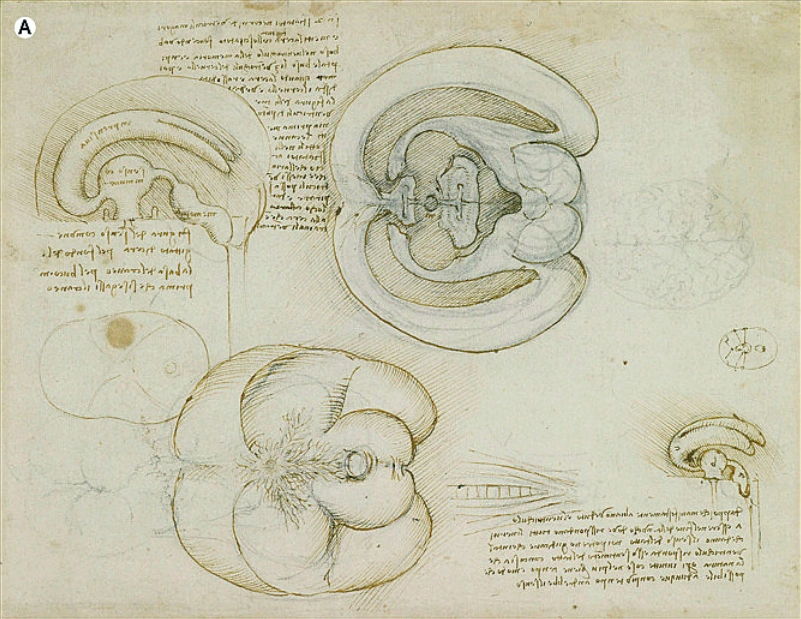
A modern analysis of Leonardo's drawings of the heart valves, published in the Journal of the Royal Society Interface (2014), confirmed that his descriptions of swirling blood flow are accurate – and anticipated modern cardiology by more than 400 years. Scientists used his sketches as the basis for computer simulations of blood flow.
He discovered things medicine had no words for yet
Leonardo did not dissect just one or two people. He dissected people of different ages, sexes and states of health – from children to old men. And it was precisely this comparison that allowed him to see things others had missed.
In Florence he met a man who claimed to be over 100 years old and in perfect health. When the old man died painlessly not long after, Leonardo performed an autopsy. He found twisted, narrowed and clogged vessels – coronary sclerosis. The vessels of a dissected child were smooth and open by comparison. For the first time in history he had described the pathology of vascular ageing.
During one dissection he came across a person whose internal organs were on the opposite side of the body from normal – the liver and spleen reversed. He drew and described it precisely, without knowing how rare the condition was.
He was the first to draw in detail an atrial septal defect – an opening between the heart's atria (foramen ovale) that normally closes after birth. In some adults it remained open. Leonardo speculated about the effect this had on the mixing of blood.
In alcoholics and elderly people he noticed that the liver was shrivelled, hard and full of nodules. He correctly linked this to fluid accumulation in the abdomen – ascites. He described liver cirrhosis before a name for it even existed.
Leonardo combined the skills of a sculptor (working with wax), an engineer (fluid dynamics) and a curious physician. No single role was enough on its own – he needed all three at once.
Arterial stiffness: Leonardo didn't know how to stop it. We do.
Leonardo was the first to describe what happens to blood vessels as we age – they narrow, harden and lose their patency. He had no idea how to reverse it. Today we have an answer.
Pentyll Pulse
A natural dietary supplement designed to support vascular health and normal blood circulation. Regular use helps keep blood vessels open and flexible – exactly the difference Leonardo observed between a healthy body and a diseased one.
Learn more about Pentyll Pulse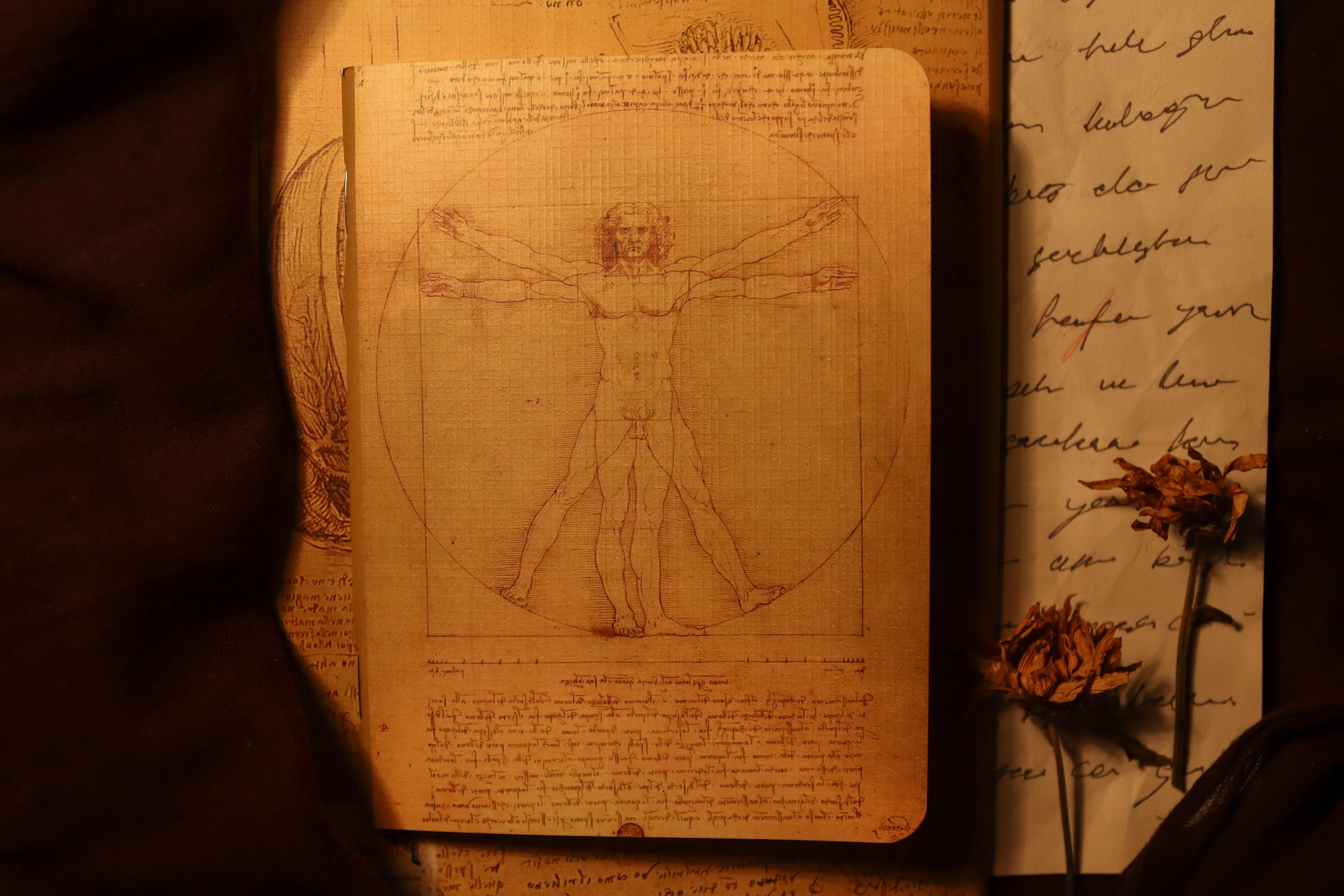
7,000 pages the world ignored
Leonardo recorded everything in notebooks he carried with him at all times. He wrote in mirror script – right to left – and encrypted part of his notes on top of that. More than 7,000 pages survive in total. When he died at the age of 67, he passed them to his loyal pupil and friend Francesco Melzi.
Melzi guarded the notebooks carefully until his own death. Then they scattered across the world – sold, divided, lost. Some ended up in private collections, some in royal archives. Not all the pages have been deciphered to this day. Scholars agree: had medicine had access to all of Leonardo's anatomical findings immediately after his death, it would have advanced by 300 years.
It didn't happen. The notebooks were ignored.
The largest surviving collections are held at the Royal Library at Windsor (anatomical drawings), the Biblioteca Ambrosiana in Milan (Codex Atlanticus – over 1,100 folios) and the National Library in Madrid. New pages continue to surface to this day.
Three paintings he never gave away
Of all Leonardo's paintings – at most 15 to 20 survive – three are exceptional. He never sold them. He never gave them away. He carried them with him constantly and bequeathed them to Melzi as a personal legacy.
Painted on commission for the Florentine merchant Francesco del Giocondo. Leonardo never delivered it. Why? We don't know for certain. He worked on it for over 10 years and kept “refining” it.
Also a commission – this time for the King of France. Also never delivered. Leonardo took it with him to France, where he died.
This one appears to have come entirely from Leonardo's own initiative – no commission, no client. A mysterious smile, an ambiguous gesture. As if the painting is saying something – but only to those who know what to look for.
You might also enjoy
A genius who didn't fit in any box
Leonardo da Vinci was a painter only because that was the most comprehensible label for the people around him. In reality he was something his era had no word for yet: a systems thinker. A person who saw connections where others saw only separate disciplines.
He injected wax into a dead brain and saw the living architecture of the mind. He dissected an old man and saw the story of his vessels. He painted three pictures and never let them go – because perhaps they contained more than it was safe to show.
And the notebooks? They still haven't been read in full. Perhaps something extraordinary is still waiting for us.